
Case Study — McDonald’s In Search of Coffee Excellence: Thinking Globally, Acting Locally Part III: Case Study Two — McDonald’s By: Salman Khan
In Search of Coffee Excellence: Thinking Globally, Acting Locally Part III: Case Study Two — McDonald’s By: Salman Khan
Introduction
This chapter constitutes the third instalment of the six-part comparative research series derived from the original paper titled In Search of Coffee Excellence: Thinking Globally, Acting Locally by Salman Khan. The broader study seeks to critically examine the strategic, operational, and cultural foundations underpinning the global success of some of the world’s most recognisable food and beverage enterprises, while simultaneously extracting practical lessons applicable to South African companies aspiring toward regional and international expansion.
Abstract (Continuation)
This research paper interrogates a persistent paradox within the global food and beverage industry: why certain enterprises trading in fundamentally ordinary commodities — such as coffee, sugar-based beverages, doughnuts, and burgers — successfully transcend geographical, cultural, and economic boundaries to become globally dominant brands, while others possessing comparable, or at times superior, product quality remain confined to local or regional markets.
The study is informed by a long-standing intellectual curiosity grounded in classical management theory, particularly the seminal insights advanced by Tom Peters and Robert H. Waterman Jr. in the influential work In Search of Excellence. Their emphasis on organizational culture, disciplined execution, customer obsession, innovation, adaptability, and people-centric leadership provides an important conceptual framework through which contemporary global brands may be examined and understood.
This comparative series further explores how multinational corporations transformed simple consumer products into powerful global symbols through strategic branding, operational consistency, franchising systems, emotional customer engagement, and relentless pursuit of excellence. The research particularly seeks to identify practical and scalable lessons for South African food, beverage, hospitality, and coffee enterprises operating within increasingly competitive domestic and international markets.
At its core, this study argues that Africa, and South Africa in particular, possesses the entrepreneurial capability, cultural richness, agricultural resources, and human capital necessary to produce globally respected food and beverage brands. However, the transition from local success to international excellence requires visionary leadership, institutional discipline, strategic scalability, and a commitment to long-term brand building.
For readers who may have missed the first part of this comparative research series, the original paper titled In Search of Coffee Excellence: Thinking Globally, Acting Locally may be accessed here: Barista Academy South Africa Research Paper https://www.baristaacademysa.com/post/in-search-of-coffee-excellence-thinking-globally-acting-locally-by-salman-khan
This foundational paper provides important contextual background, research motivations, and conceptual underpinnings necessary for appreciating the broader scope and intellectual ambition of the continuing series.

Unveiling the Secrets behind McDonald's Success and Its Global Business Empire
McDonald's Corporation started in 1940 as a modest burger stand and has transformed into an iconic global fast-food leader. With over 40,000 locations across more than 100 countries, it has set a high standard in the fast-food industry. This article explores the factors driving its remarkable success and key strategies that have built its vast international empire.
A Solid Foundation: The Beginning of McDonald's
The McDonald's story began with Richard and Maurice McDonald who opened their first restaurant in San Bernardino, California. Their innovative Speedy Service System changed food service by prioritizing speed, affordability, and consistency.
This focus on operational efficiency attracted Ray Kroc, a franchise agent who saw the potential in the brothers' concept. Kroc's vision led to the creation of the franchise model that propelled McDonald's growth, helping the brand flourish beyond the initial restaurant.
3. McDonald’s: Precision, Process, and the Science of Scale
McDonald’s stands as one of the most influential business systems ever constructed in the global food and beverage industry. Unlike brands that scale through emotional resonance or experiential differentiation, McDonald’s achieved dominance through precision, process discipline, and scientific management. Its success is rooted not in culinary sophistication but in the relentless pursuit of consistency, efficiency, and replicability.
In the context of In Search of Coffee Excellence, McDonald’s offers a counterbalancing case study to Starbucks. Where Starbucks elevates coffee into culture and experience, McDonald’s reduces complexity to achieve scale. Together, the two brands represent opposing yet complementary pathways to global excellence.
Timeline Anchors: McDonald’s — Precision, Process, and Scale
1940 – McDonald brothers open drive-in restaurant
1955 – Ray Kroc launches franchising model
1960s–70s – Global expansion through standardized systems
1980s–90s – Operational excellence as competitive advantage
2000s–Present – Localization, menu diversification, digital ordering
Key Insight McDonald’s scaled not food, but operational discipline.

3.1 Humble Origins and the Franchising Revolution
McDonald’s origins date back to 1940, when Richard and Maurice McDonald redesigned their California drive-in restaurant using principles borrowed from manufacturing. By simplifying the menu and introducing an assembly-line kitchen layout, they dramatically increased speed while reducing costs and errors.
Ray Kroc’s later intervention transformed this operational innovation into a franchising revolution. Crucially, McDonald’s franchising model emphasized control before growth. Franchisees did not purchase brand freedom; they entered a tightly governed operating system. This inversion of traditional franchising norms allowed McDonald’s to scale rapidly without sacrificing uniformity.
From a management perspective, McDonald’s illustrates how entrepreneurship can be institutionalized—embedded into replicable systems rather than individual charisma.
The Franchise Model: Expansion Made Easy
Central to McDonald's success is its franchise model. By allowing individuals to own and run their restaurants under the McDonald's brand, the company mitigated the financial risks associated with growth.
As of today, about 93% of McDonald's restaurants are franchised. This strategy has enabled the brand to quickly establish a footprint in diverse markets, with franchisees deeply invested in quality and customer satisfaction due to their financial involvement. For example, in 2025, McDonald's generated over $48 billion in revenue, a significant portion attributed to its franchise operations.
South African Implications
For South African food and beverage brands, this history underscores a vital lesson: expansion without standardized operating systems often leads to inconsistency and brand erosion. McDonald’s suggests that scale should follow systems, not precede them.
McDonald’s Franchising Control Model (Conceptual)
Core Elements:
· Centralized menu engineering
· Approved supplier ecosystems
· Mandatory training protocols
· Continuous compliance auditing
Insight:Growth is permitted only within clearly defined operational boundaries.
Global Scale & Reach
· Locations: Over 40,000 restaurants operate worldwide, with the vast majority (over 93%) being owned and operated by independent franchisees.
· Sales Speed: The company sells over 75 hamburgers every single second.
· Toy Distribution: It is the world's largest distributor of toys, featuring one in roughly \(20\%\) of all sales (primarily through Happy Meals)
McDonald’s South Africa
· McDonald’s opened its doors in South Africa in 1995
· Today, close to 400 restaurants in all nine provinces across South Africa
· Serving over 8 million customers per month
· Employing over 12 000 people
· Voted Deloitte Best Company to Work for 2009, 2010, 2011
McDonald's Global Success Illustrations:
Figure 1.

Figure 2.
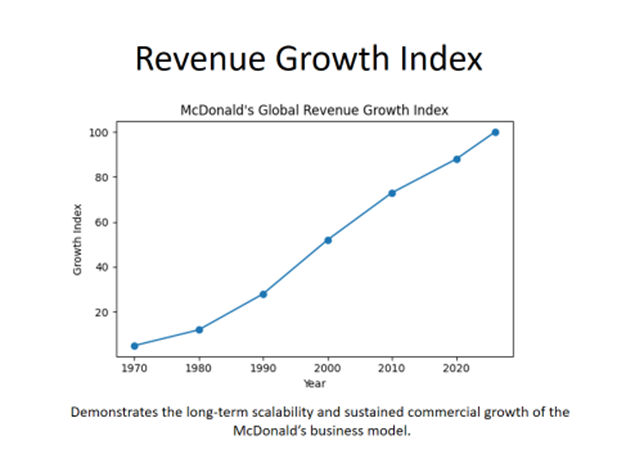
Figure 3.

3.2 Operational Excellence and System Thinking
McDonald’s operational philosophy is rooted in system thinking, where performance emerges from the interaction of standardized components rather than individual skill. Every movement in the kitchen is choreographed, measured, and optimized. Equipment, workflows, and staff roles are engineered to minimize variance and maximize throughput.
Training is procedural rather than artisanal, enabling rapid workforce onboarding across diverse socio-economic contexts. Supply chains are vertically coordinated, ensuring cost control, food safety, and availability at global scale. This approach aligns closely with operations strategy literature, demonstrating how process discipline can outperform product differentiation in high-volume markets.
South African Implications
In emerging markets like South Africa—where skills shortages and labor turnover are persistent challenges—system-based operations offer resilience. McDonald’s model suggests that excellence can be designed into processes, reducing dependence on scarce human capital.
Figure 4: McDonald’s Operating System Architecture
Layer | Function |
Process Design | Standardized workflows |
Training Systems | Rapid skill transfer |
Supply Chain | Integrated logistics |
Quality Control | Centralized auditing |
Brand Governance | Uniform customer promise |
3.3 Consistency, Speed, and Customer Trust
McDonald’s brand equity is built less on aspiration than on assurance. Customers return not for surprise, but for certainty. The brand’s ability to deliver identical outcomes—across time, geography, and personnel—has cultivated deep consumer trust.
Speed amplifies this trust. By reducing waiting time and cognitive effort, McDonald’s positions itself as a default solution in time-constrained environments. Over decades, this reliability has embedded the brand into daily routines, creating habitual loyalty rather than emotional attachment.
From a behavioral economics standpoint, McDonald’s demonstrates how predictability reduces decision fatigue, reinforcing repeat consumption.
South African Implications
For local brands competing against global players, McDonald’s highlights the underestimated power of consistency. Many South African food ventures fail not due to poor concepts, but due to inconsistent execution across locations.
3.4 Localization Within a Global Standard
Despite its reputation for uniformity, McDonald’s practices controlled localization. Menu adaptations reflect religious, cultural, and dietary requirements, yet operational systems remain untouched. Localization occurs at the output level, not the process level.
This strategic separation allows McDonald’s to respect cultural diversity without fragmenting its operational backbone. It is a form of disciplined globalization—flexible on the surface, rigid at the core.
Menu Innovation: Catering to Local Tastes
Another key to McDonald's success is its ability to adapt its menu to local cultures. While favorites like the Big Mac continue to be staples, McDonald's frequently introduces regional dishes that align with local preferences.
1. India: The Ultimate Vegetarian & Non-Beef Adaptability
Because cows are sacred to the Hindu majority and pork is restricted by Muslim consumers, McDonald’s India completely revamped its menu upon entry in 1996.
Maharaja Mac: Instead of beef, this flagship burger uses chicken (or paneer) patties, topped with jalapeños, onions, and a spicy sauce.
McAloo Tikki: A massively popular, budget-friendly burger featuring a fried potato and pea patty, catering to vegetarians.
McSpicy Paneer: A crispy paneer (cottage cheese) patty coated in spicy batter.
2. Japan: Unique Flavors and Seasonal Items
Japan features some of the most innovative menu adaptations, focusing on seasonal changes and unique ingredients.
Teriyaki Burger: A pork or beef patty with tangy teriyaki sauce, a staple in Japan.
Ebi Filet-O: A fried shrimp patty burger.
Tsukimi Burger: A "moon-viewing" burger served in autumn, featuring a sunny-side-up egg and smoky sauce.
Shaka Shaka Fries: Fries served with a powder packet (like Seaweed or Cheese) that customers shake to mix.
3. Southeast Asia: Rice and Heat
In regions where rice is a staple, McDonald's integrated it into the main menu.
Chicken McDo with Spaghetti (Philippines): A popular combo featuring fried chicken served with spaghetti in a sweet red sauce.
Nasi Lemak McD (Malaysia): Coconut rice, anchovies, peanuts, and sambal (spicy paste) served in a burger form or traditional set.
Pineapple McSpicy (Australia): A fiery chicken burger balanced with a slice of grilled pineapple.
4. Europe: Regional Classics and Beer
McDonald's in Europe often highlights local savory flavors and, in some countries, local beverages.
McKroket (Netherlands): A deep-fried ragout patty served on a bun with mustard.
McRaclette (Switzerland): A burger topped with melted raclette cheese, potatoes, and special sauce.
Beer (Germany): Select German outlets serve local beer, acknowledging the cultural importance of beer in German dining.
Parmigiano Reggiano (Italy): The "McItaly" line has featured products with local cheeses and balsamic vinegar.
5. Middle East & Africa: Local Ingredients
McArabia (Middle East): Grilled chicken or Kofta patties wrapped in traditional Arabic flatbread with tahini, tomatoes, and lettuce.
Boerewors Burger (South Africa): Inspired by local South African farmer's sausage.
Ramadan Menu (Morocco): Special iftar meals featuring traditional dates, soup, and milk to break the fast.
6. Canada: Poutine
Poutine: Fries topped with cheese curds and gravy, adapted from the Quebecois classic, available nationwide.
Key Takeaway:
McDonald's adaptability is not just about changing ingredients; it's about respecting local culture. According to experts, this localization strategy accounts for nearly 30% of their international sales.
South African Implications
South African brands aspiring to regional or continental expansion can learn from this model: adapt taste and presentation, but protect systems. Cultural relevance should not come at the expense of operational discipline.
Figure 5: Localization Framework
· Fixed: Processes, training, quality standards
· Flexible: Menu items, flavor profiles, marketing cues
Embracing Technology: Efficiency and Customer Engagement
In today’s digital era, McDonald's has embraced technology to enhance the customer experience. Initiatives such as self-service kiosks, mobile ordering apps, and partnerships with delivery services have streamlined operations and improved customer convenience.
These technological advancements have increased operational efficiency. For instance, self-service kiosks have reduced wait times by an average of 20%. Such innovations resonate particularly with younger consumers, keeping McDonald's relevant in a tech-savvy world.
Marketing Magic: Creating a Global Brand
Marketing is vital to McDonald's success as a global brand. Through compelling advertising, engaging promotions, and family-friendly products, McDonald's has built a strong brand identity. A striking aspect of McDonald's marketing is its ability to evoke nostalgia. Campaigns like "I'm Lovin' It" reinforce emotional connections, making McDonald's more than just a place to eat—it's a beloved part of many people's lives. This emotional branding approach has helped maintain McDonald's appeal across generations.
McDonald’s has perfected the art of "glocalization"—thinking globally to maintain a consistent brand identity, while acting locally to resonate with regional tastes. This balance of consistency and adaptability is the core of its marketing magic.
Here are examples of McDonald’s marketing strategies that created a global brand:
1. Glocalization: The "Mc" Adaptation Strategy
McDonald's maintains core products (Big Mac, Fries, McNuggets) but adapts its menu to local cultures.
India (McAloo Tikki & Maharaja Mac): Because beef and pork are not consumed by a large portion of the population, McDonald’s India created vegetarian options like the McAloo Tikki (spiced potato patty) and Maharaja Mac (chicken-based Big Mac).
Japan (Teriyaki Burger & Seasonal Items): Japan features the Teriyaki McBurger and seasonal items like the Tsukimi (Moon Viewing) Burger in autumn, aligning with local tastes and cultural festivities.
France (McBaguette): Recognizing local culinary traditions, McDonald's France introduced the McBaguette and higher-quality cheeses to match a more refined café culture.
2. Celebrity Collaborations & Cultural Relevance
Rather than traditional advertising alone, McDonald's turns its food into a cultural event by partnering with pop culture icons.
The Travis Scott Meal (2020): This campaign combined a limited-time menu item with exclusive merchandise. It was so popular that some locations ran out of ingredients, effectively tapping into younger, urban demographics.
The BTS Meal (2021): This global collaboration featuring Chicken McNuggets and Korean-inspired sauces launched in over 50 countries, leveraging the international power of a K-Pop fandom.
3. Iconic Visual Marketing (Global Consistency)
McDonald’s uses consistent branding that is instantly recognizable worldwide.
"Follow the Arches" (2018): In Canada, McDonald's won awards for billboards that featured only cropped portions of the Golden Arches. This demonstrated that the brand is so iconic, the full logo isn't needed for identification.
"I'm Lovin' It" Jingle: Launched in 2003, this is one of the longest-running and most successful emotional branding campaigns in history, creating a "feel-good" association across cultures.
McDonald Brand Logo Evolution Journey 1940-2006
Figure 5.
Layer | Function |
Process Design | Standardized workflows |
Training Systems | Rapid skill transfer |
Supply Chain | Integrated logistics |
Quality Control | Centralized auditing |
Brand Governance | Uniform customer promise |
The evolution of the McDonald's logo from its early architectural origins to the modern minimalist “Golden Arches” represents far more than a simple visual redesign; it reflects the transformation of the company itself from a small regional hamburger outlet into one of the most recognisable global brands in modern commercial history. Since the introduction of the iconic arches during the 1950s, the logo underwent several refinements aimed at enhancing simplicity, memorability, and universal brand recognition across diverse international markets. Over successive decades, McDonald’s strategically streamlined its visual identity by reducing clutter, modernising typography, and emphasising the now-famous golden “M,” which became synonymous with consistency, affordability, convenience, and familiarity. By 2026, the logo had evolved into a minimalist global symbol capable of transcending language, culture, and geography — demonstrating the immense power of visual branding in shaping consumer perception and loyalty.
The gradual refinement of the McDonald’s brand identity also illustrates an important lesson in corporate adaptability and strategic continuity. While the company modernised its logo to remain relevant to changing consumer preferences and contemporary design aesthetics, it simultaneously preserved its core visual essence and historical identity. This balance between innovation and continuity enabled McDonald's to maintain generational trust while continuously appealing to younger audiences in increasingly competitive markets. For South African food and beverage enterprises, the McDonald’s logo evolution underscores the importance of building enduring brand symbols capable of communicating quality, reliability, and emotional familiarity. Strong visual branding, when combined with operational excellence and customer consistency, can transform ordinary products into globally admired commercial institutions.
4. Tech-Driven Convenience and Personalization
McDonald's ensures its brand is associated with ease, speed, and modern technology.
Mobile App & Loyalty Program: The McDonald's app offers tailored promotions based on previous purchases, strengthening customer loyalty with over 120 million downloads globally.
AI-Powered Drive-Thrus: The company has invested in AI to suggest menu items based on time of day, weather, and traffic patterns, setting the standard for fast-food efficiency.
5. Emotional Branding and Social Responsibility
McDonald's builds loyalty by fostering emotional connections, starting from childhood.
Happy Meals (1979): The combination of food with a toy creates a lasting, nostalgic connection for children, which often results in them passing that loyalty to their own families later.
Ronald McDonald House Charities (RMHC): This philanthropic arm builds positive rand image by providing housing and support for families with sick children, showing that the company gives back to the community.
Summary of Key Takeaways:
Adapt without losing identity: Localize your product to fit cultural needs, but keep core brand visual assets (logos, colors) consistent.
Be a "cultural moment" maker: Don't just sell products; partner with influencers or create experiences that make your brand part of everyday conversation.
Prioritize seamless experiences: Invest in technology that removes friction, making purchasing faster and more personalized.
McDonald's "customer service magic" often stems from turning a highly automated, high-volume process into a personalized experience. Based on recent customer stories and service studies, here are several examples of McDonald's customer service magic.
1. The "We Say Yes" Philosophy (Proactive Empathy)
A powerful example comes from a McDonald's manager who transformed their service culture by moving from rigid policy to empowerment.
The Magic: A customer wanted extra pickles and onions on a specialty burger, but the system didn't allow for the specific type of toppings requested. Instead of refusing, the employee was taught to "Give them the pickle" (give them what they want) to ensure a happy, returning customer. This shift in mindset from "no" to "yes" built trust and loyalty.
2. Turning Mistakes into Connections
While consistency is key, mistakes happen. The "magic" occurs in how staff handle them.
The Magic: A customer ordered a Big Mac, arrived home, and realized there was no meat on the burger. Instead of becoming angry, the customer returned and was met with kindness, laughter, and a fresh, correct meal. This highlights a human moment where kindness—rather than harsh frustration—repaired the relationship and created a memorable positive experience.
3. Personalization in a Digital World
Despite the rise of self-ordering kiosks, McDonald’s still creates personal moments.
The Magic: In some regions, McDonald's has focused on reducing the stress of ordering by aligning service teams to help customers—especially those less comfortable with technology—at the kiosks.
The Magic: In certain delivery contexts, teams have gone as far as redesigning packaging to include warm, Thank-You messages in local languages to make the experience more personal and heartfelt.
4. "Billions Heard" - Listening to Customers
McDonald's has evolved from "Billions Served" to "Billions Heard," actively listening to social media feedback to improve service.
The Magic: The introduction of all-day breakfast was a direct response to customer demand, with over 120,000 tweets asking for it within one year. This shows a magical ability to adapt their operational structure to meet customer desires at scale.
5. The "Comfort" Factor (Consistency as Service)
The Magic: While not a "magical" individual gesture, the brand’s ability to deliver the exact same experience in Tokyo as in New York offers a profound sense of comfort, reliability, and security to travelers and families, which is a form of exceptional service.
6. The "Human" Touch in High-Volume Moments
The Magic: The "Customer Experience Leaders" in restaurants are designated to go beyond simply taking orders, actively ensuring customers feel welcomed and supported (e.g., assisting with table service).
For your blog, the overarching theme is that McDonald's magic lies in balancing technology with humanity
Some interesting fact and figures about McDonald
Figure 5.

Real Estate Strategy: Location Matters
An important yet often overlooked factor in McDonald’s success is its real estate strategy. Rather than simply leasing locations, McDonald's chooses to own the land and buildings for its franchises.
This approach enhances control and financial stability. For instance, owning properties allows McDonald's to develop long-term relationships with franchisees while generating steady rental income. This strategy has yielded significant benefits, with the company owning about 45% of its locations worldwide. McDonald's is often described not as a fast-food company, but as a real estate company that happens to sell burgers. Their "Location Matters" strategy is the cornerstone of their global success, focusing on owning the land, controlling the prime spot, and creating high-traffic, high-value assets.
1. Prime High-Traffic Intersections ("Main & Main")
The Strategy: McDonald's often targets the corner of the busiest intersections in town—sometimes called the "Main and Main" location.
The Example: Instead of just renting a retail space, McDonald's purchases the land at major suburban intersections or downtown high-traffic areas, ensuring high visibility and foot traffic.
The Outcome: The land value appreciates over time, providing a solid asset for the company while guaranteeing high visibility for the franchisee.
2. Strategic "Drive-Thru" Evolution
The Strategy: As consumer habits changed, McDonald's adjusted its real estate to prioritize drive-thru accessibility over sit-down dining.
The Example: In the 1970s and 80s, they added drive-thru lanes around existing buildings, increasing the site size to include around 300 square meters extra per site.
The Outcome: This increased revenue per site by 25%, demonstrating that the physical, accessible structure is more important than the indoor dining space.
3. Vertical Integration: The "Developer" Model
The Strategy: McDonald's acts as the landlord, purchasing the land and building the restaurant, then leasing it to franchisees.
The Example: A franchisee pays an initial fee but does not own the property. They pay rent to McDonald's, which is often calculated based on a percentage of sales.
The Outcome: This allows McDonald's to control the location forever and ensure that if a franchisee fails, the land and building remain a valuable company asset.
4. High-Convenience Locations (Airports, Schools, Malls)
The Strategy: Placing restaurants exactly where people are already gathering or passing through to capture demand.
The Example: McDonald's secures long-term leases or land ownership in airport terminals, near university campuses, and within shopping malls.
The Outcome: These spots guarantee a captive, steady stream of customers, often operating 24/7 or matching the heavy traffic hours of the anchor amenity.
5. Adaptable Urban Footprints (Small vs. Large Sites)
The Strategy: Using real estate data to adapt the type of location to the environment.
The Example: In dense, bustling cities, McDonald's invests in smaller, high-foot-traffic footprints optimized for quick service or pickup.
The Example: In rural or highway areas, they focus on large plots (2,000–4,000 sq m) to accommodate parking, play areas, and drive-thrus.
Summary for takeaway:
Core Principle: Location is critical to the brand's ability to consistently drive customer demand.
Secret Sauce: By owning the real estate, they generate massive, stable revenue from rent, regardless of food sales fluctuations.
Visibility & Accessibility: The goal is to be easily seen, easy to access, and impossible to miss.
Sustainability Initiatives: A Modern Approach
In recent years, McDonald's has focused on sustainability, responding to the growing demand for responsible business practices. The company is committed to sustainable sourcing, reducing its carbon footprint, and minimizing waste.
For example, McDonald's aims to source all of its packaging from renewable or recycled sources by 2025. These initiatives not only align with consumer values but also help cultivate a positive public image, appealing to a demographic increasingly concerned with sustainability.
The Global Reach: McDonald’s Footprint
Today, McDonald’s boasts an impressive global presence, operating in more than 100 countries. The company skillfully tailors its approach to meet local community needs while maintaining the core identity of the brand.
Their extensive supply chain network ensures consistent delivery of ingredients and products worldwide. For example, each region can adapt its menu to reflect local tastes while ensuring high standards of quality and service are maintained.
Challenges and Adaptations: Navigating the Future
Despite its impressive track record, McDonald's faces challenges such as increased competition, changing consumer preferences, and growing health concerns.
In response, the company has reformulated its menu, actively offering healthier options, and providing transparent nutritional information for its products. These changes demonstrate McDonald’s willingness to adapt to market demands and evolving consumer expectations, ensuring it remains relevant and competitive.
Reflecting on McDonald's Journey
McDonald's success story is one of continuous innovation, adaptation, and strategic foresight. From its humble beginnings to its strong global presence, the company has shown that understanding customer needs and maintaining a flexible approach are essential in the fast-food industry.
By balancing various elements—menu diversification, technological integration, sustainability, and strategic real estate—McDonald's reinforces its status as a global business titan. Observing how McDonald's continues to engage with challenges and foster evolution will be fascinating in the years to come.
Closing Reflection: McDonald’s and Coffee Excellence
While McDonald’s is not traditionally associated with specialty coffee, its later success with McCafé illustrates how operational mastery enables category extension. Excellence, in this model, is not artisanal depth but repeatable reliability.
For coffee brands in emerging markets, McDonald’s offers a sobering yet empowering insight: global relevance is often earned through discipline before distinction.
Conclusion
The remarkable global success and expansion of McDonald's offers profound lessons for South African food and beverage enterprises seeking sustainable growth, international relevance, and enduring brand recognition. From a modest hamburger outlet in the United States to one of the most recognisable brands in the world, McDonald’s demonstrated that consistency, operational efficiency, localisation, innovation, and strong brand identity are the cornerstones of global commercial success.
One of the defining strengths of McDonald’s lies in its ability to standardise quality and customer experience across diverse markets while simultaneously adapting to local cultures, tastes, and consumer preferences. This balance between global standards and local relevance enabled the company to penetrate markets across continents without losing its core identity. South African companies, particularly within the coffee, hospitality, and food sectors, can draw valuable lessons from this model by maintaining uncompromising quality standards while embracing Africa’s rich culinary diversity and cultural uniqueness.
Furthermore, McDonald’s invested heavily in systems, staff training, supply chain management, franchising models, and customer-centric innovation. Its success was not accidental, but rather the outcome of disciplined execution, long-term strategic planning, and relentless operational refinement. South African enterprises aspiring to compete internationally must recognise that sustainable expansion requires more than a good product; it demands institutional excellence, leadership development, scalability, and investment in human capital.
Another important lesson is the power of branding and emotional connection with consumers. McDonald’s transformed itself into more than a restaurant chain; it became a global cultural symbol associated with familiarity, affordability, convenience, and trust. South African food and beverage brands possess enormous untapped potential to build globally admired brands rooted in African authenticity, ethical sourcing, indigenous flavours, and premium customer experiences. In an era where consumers increasingly value storytelling, sustainability, and authenticity, African enterprises have a unique opportunity to position themselves distinctively in international markets.
For South Africa’s coffee industry in particular, the McDonald’s case study underscores the importance of accessibility, consistency, franchise expansion, digital integration, and customer loyalty programmes. Local coffee brands and café chains must move beyond fragmented growth strategies and embrace structured business models capable of regional and global scalability. Africa should no longer merely serve as a supplier of raw commodities to the world, but as a creator of internationally respected brands and experiences.
Ultimately, the McDonald’s story illustrates that global success is not confined to Western corporations alone. With visionary leadership, operational discipline, innovation, and a commitment to excellence, South African food and beverage companies can emerge as influential global players. The challenge for African entrepreneurs and industry leaders is not whether they possess the capability to compete internationally, but whether they are prepared to cultivate the consistency, ambition, and strategic foresight required to achieve enduring global excellence
Transition 3: From McDonald’s to Krispy Kreme
Closing Part III: McDonald’s
McDonald’s reveals the power of systems, franchising logic, and operational excellence in delivering consistency at scale. However, global success does not always follow a linear or frictionless path. Some brands grow through emotional attachment, sensory appeal, and controlled scarcity—often encountering volatility along the way. To explore these dynamics, the next installment examines Krispy Kreme, a brand whose expansion highlights both the strengths and vulnerabilities of emotionally driven growth in global markets.
Transition to the Next Case Study
If Starbucks humanized coffee through experience and McDonald’s industrialized food through process, the next case—Krispy Kreme—reveals the power of emotional attachment to a single product, executed with obsessive focus.
In my quest for “In search of coffee excellence” will continue in next chapter to draw lesson from global success of Krispy Kreme and until we climb the final summit for “In Search of Coffee Excellence for South Africa Companies” till then keep brewing.
About Author:

Salman Khan is a Barista judge, internationally acclaimed human rights activist, social entrepreneur, food and drink anthropologist, researcher and culinary educator.
To access 2024 coffee consumer survey report in South Africa please send an email to by a copy of it.
WhatsApp 082 691 6048
#coffeesustainbility #ecological #envirnomentalstewardship #coffeefairtrade #sauNotoexploitation #coffeeequitability #SCA #coffeecommunity #arabia #robusta #fairtrade #Africacoffee #coffeeplantation #coffeetourism #DTIc #Tourism #agriculture #climatechange #baristaguild #CoffeeUSA #CoffeeEU #CoffeeManagize #coffeeroasters #coffeeUAE #CoffeeBeans #UNITC #WTO #UJ #Wits #UKZN #UCT
References — McDonald’s Case Study
· Kroc, R., & Anderson, R. (1977). Grinding It Out: The Making of McDonald’s. Chicago, IL: Contemporary Books.
· Love, J. F. (1986). McDonald’s: Behind the Arches. New York, NY: Bantam Books.
· Ritzer, G. (2015). The McDonaldization of Society (8th ed.). Thousand Oaks, CA: Sage.
· Porter, M. E. (1985). Competitive Advantage: Creating and Sustaining Superior Performance. New York, NY: Free Press.
· McDonald’s Corporation. (2023). Global Impact Report. Chicago, IL.
· Hill, C. W. L. (2020). International Business: Competing in the Global Marketplace (13th ed.). New York, NY: McGraw-Hill.
Appendix C: References and Further Reading
Foundational Management and Strategy Literature
Peters, T., & Waterman, R. H. (1982). In Search of Excellence: Lessons from America’s Best-Run Companies. New York: Harper & Row.
Porter, M. E. (1985). Competitive Advantage: Creating and Sustaining Superior Performance. New York: Free Press.
Mintzberg, H. (1994). The Rise and Fall of Strategic Planning. New York: Free Press.
Branding, Marketing, and Consumer Culture
Aaker, D. A. (1996). Building Strong Brands. New York: Free Press.
Keller, K. L. (2013). Strategic Brand Management (4th ed.). Harlow: Pearson.
Holt, D. B. (2004). How Brands Become Icons: The Principles of Cultural Branding. Boston: Harvard Business School Press.
Globalization and Multinational Enterprises
Bartlett, C. A., & Ghoshal, S. (1989). Managing Across Borders: The Transnational Solution. Boston: Harvard Business School Press.
Rugman, A. M., & Collinson, S. (2012). International Business (6th ed.). Harlow: Pearson.
Levitt, T. (1983). “The Globalization of Markets.” Harvard Business Review, 61(3), 92–102.
Industry-Specific and Practitioner Sources
Schultz, H., & Yang, D. J. (1997). Pour Your Heart Into It: How Starbucks Built a Company One Cup at a Time. New York: Hyperion.
Love, J. F. (1995). McDonald’s: Behind the Arches. New York: Bantam Books.
Pendergrast, M. (2013). For God, Country, and Coca-Cola. New York: Basic Books.
Coffee Economy and Emerging Market Perspectives
Ponte, S. (2002). “The ‘Latte Revolution’? Regulation, Markets and Consumption in the Global Coffee Chain.” World Development, 30(7), 1099–1122.
Talbot, J. M. (2004). Grounds for Agreement: The Political Economy of the Coffee Commodity Chain. Lanham: Rowman & Littlefield.
International Coffee Organization (ICO). Selected reports and statistical publications.


Comments