
In Search of Coffee Excellence: Thinking Globally, Acting Locally Part 1V: Case Study three of Krispy Kreme: Salman Khan
IN SEARCH OF COFFEE EXCELLENCE: THINKING GLOBALLY, ACTING LOCALLY
Introduction
This chapter constitutes the third instalment of the six-part comparative research series derived from the original paper titled In Search of Coffee Excellence: Thinking Globally, Acting Locally by Salman Khan. The broader study seeks to critically examine the strategic, operational, and cultural foundations underpinning the global success of some of the world’s most recognisable food and beverage enterprises, while simultaneously extracting practical lessons applicable to South African companies aspiring toward regional and international expansion.
Abstract (Continuation)
This research paper interrogates a persistent paradox within the global food and beverage industry: why certain enterprises trading in fundamentally ordinary commodities — such as coffee, sugar-based beverages, doughnuts, and burgers — successfully transcend geographical, cultural, and economic boundaries to become globally dominant brands, while others possessing comparable, or at times superior, product quality remain confined to local or regional markets.
The study is informed by a long-standing intellectual curiosity grounded in classical management theory, particularly the seminal insights advanced by Tom Peters and Robert H. Waterman Jr. in the influential work In Search of Excellence. Their emphasis on organizational culture, disciplined execution, customer obsession, innovation, adaptability, and people-centric leadership provides an important conceptual framework through which contemporary global brands may be examined and understood.
This comparative series further explores how multinational corporations transformed simple consumer products into powerful global symbols through strategic branding, operational consistency, franchising systems, emotional customer engagement, and relentless pursuit of excellence. The research particularly seeks to identify practical and scalable lessons for South African food, beverage, hospitality, and coffee enterprises operating within increasingly competitive domestic and international markets.
At its core, this study argues that Africa, and South Africa in particular, possesses the entrepreneurial capability, cultural richness, agricultural resources, and human capital necessary to produce globally respected food and beverage brands. However, the transition from local success to international excellence requires visionary leadership, institutional discipline, strategic scalability, and a commitment to long-term brand building.
For readers who may have missed the first part of this comparative research series, the original paper titled In Search of Coffee Excellence: Thinking Globally, Acting Locally may be accessed here: Barista Academy South Africa Research Paper https://www.baristaacademysa.com/post/in-search-of-coffee-excellence-thinking-globally-acting-locally-by-salman-khan
This foundational paper provides important contextual background, research motivations, and conceptual underpinnings necessary for appreciating the broader scope and intellectual ambition of the continuing series.
Case Study Three: Krispy Kreme – Transforming Simplicity into Global Excellence
Introduction
The journey towards excellence often begins with a deceptively simple question: Why do some businesses become globally admired while thousands of others, selling virtually identical products, remain local enterprises? This question lies at the heart of this comparative research series, In Search of Coffee Excellence: Thinking Globally, Acting Locally, which seeks to uncover the strategic principles that enable ordinary businesses to achieve extraordinary success.

Throughout history, many of the world's most successful food and beverage companies have not built their reputations on revolutionary inventions or highly sophisticated technologies. Instead, they have transformed everyday products into globally recognised brands through visionary leadership, operational discipline, exceptional customer experiences, relentless innovation, and the consistent execution of a clearly defined purpose. Their products are often remarkably ordinary; however, the organisations behind those products are anything but ordinary.
Among these remarkable enterprises, Krispy Kreme presents one of the most fascinating examples of commercial excellence. Established in 1937, the company built an international business around one of the simplest bakery products imaginable—a yeast-raised doughnut. Flour, sugar, yeast, eggs, milk and glaze are ingredients available in virtually every country in the world, and countless independent bakeries produce doughnuts of equal or even superior quality. Yet only one brand transformed this humble product into a globally recognised symbol of freshness, indulgence and customer delight.
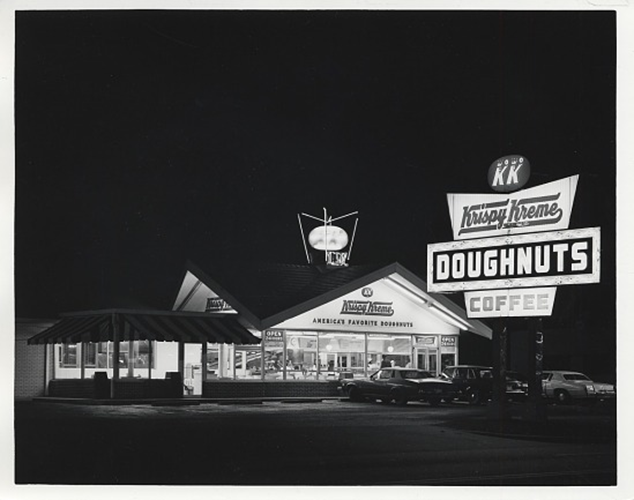
Krispy Kreme mid 1970s stores outlook
This apparent contradiction forms the central inquiry of this chapter. If product quality alone cannot explain Krispy Kreme's remarkable success, then what factors enabled the organisation to expand from a single neighbourhood bakery into a multinational enterprise operating across diverse markets and cultures? More importantly, what practical lessons can coffee entrepreneurs, café owners, hospitality professionals and emerging South African brands draw from this remarkable journey?
These questions resonate strongly with the work of Peters and Waterman in In Search of Excellence, which argued that enduring organisational success rarely results from superior products alone. Instead, excellence emerges from strong organisational cultures, close relationships with customers, disciplined management systems, empowered employees, continuous innovation and an unwavering commitment to delivering value. Decades after its publication, these principles remain strikingly relevant in today's highly competitive food and beverage industry.
Krispy Kreme exemplifies many of these characteristics. Rather than competing solely on price or product features, the company created an emotional relationship with consumers by transforming the simple act of purchasing a doughnut into a memorable experience. Customers were not merely buying food; they were witnessing craftsmanship, participating in a tradition and becoming part of a brand story centred on freshness, authenticity and joy. The famous "Hot Now" sign, the open production theatre and the aroma of freshly glazed doughnuts collectively became strategic assets that competitors found difficult to replicate.
This observation carries profound implications for the coffee industry. Around the world, millions of cafés purchase high-quality coffee beans from similar origins, utilise comparable espresso equipment and employ trained baristas. Yet only a relatively small number evolve into iconic brands capable of sustained growth and international recognition. The difference seldom lies in the coffee itself. Instead, it resides in leadership, organisational culture, customer experience, operational consistency, innovation and the ability to create meaningful emotional connections with consumers.
For South Africa, where the speciality coffee sector continues to mature amidst growing competition, these lessons are particularly significant. Independent cafés, coffee roasters and hospitality businesses often focus considerable attention on sourcing premium beans and investing in modern equipment, while underestimating the strategic importance of brand identity, service excellence, customer engagement and organisational systems. Krispy Kreme demonstrates that sustainable competitive advantage is built not only through product excellence but through the disciplined orchestration of every element of the customer experience.
Consequently, this chapter examines Krispy Kreme through the broader lens of strategic management and organisational excellence rather than as a simple corporate history. It explores the company's entrepreneurial origins, leadership philosophy, business model, customer experience strategy, franchising system, operational excellence, marketing approach and international expansion. Each dimension is evaluated to identify the underlying principles that transformed an ordinary bakery into one of the world's most recognised food-service brands.
Ultimately, this case study seeks to reinforce the overarching proposition of this research series: global excellence is not achieved by selling extraordinary products but by executing ordinary products extraordinarily well. For entrepreneurs, coffee professionals and hospitality leaders seeking to elevate South African brands onto the international stage, the Krispy Kreme story offers compelling evidence that sustainable success begins with disciplined execution, authentic customer value and an unwavering commitment to excellence. Thinking globally while acting locally therefore becomes not merely a slogan but a strategic philosophy capable of transforming local enterprises into globally competitive brands.
The Krispy Kreme case study will allow us to explore several powerful themes relevant to South African and African food and beverage enterprises:
Experiential retail and customer engagement
Brand nostalgia and emotional marketing
Product consistency and signature offerings
Franchising and scalable growth models
Strategic store positioning and visibility
Integration of coffee culture with complementary products
Premium yet accessible consumer experiences
Innovation while preserving heritage and authenticity
I positioned position the Krispy Kreme chapter as a contrast to McDonald's. While McDonald’s mastered mass-scale operational efficiency, Krispy Kreme excelled through experiential branding, emotional connection, and specialty product differentiation. Together, these models provide a rich comparative framework for African enterprises seeking different pathways to growth and market leadership.
1. The History and Evolution of Krispy Kreme: From Local Bakery to Global Icon
Timeline Anchors: Krispy Kreme — Theatre, Emotion, and Controlled Growth
· 1937 – Founded with a secret doughnut recipe
· 1950s–90s – Regional cult following in the U.S.
· Early 2000s – Rapid global expansion
· Mid-2000s – Market correction and retrenchment
· 2010s–Present – Brand refocus and selective growth

Key Insight Callout:Emotional branding can accelerate growth—but also amplify risk.
Origins and the Cult of the Original Glazed
Founded in 1937 in North Carolina, Krispy Kreme began as a wholesale doughnut supplier before transitioning into retail. Its signature Original Glazed doughnut became the centerpiece of the brand’s identity—unchanged in recipe, presentation, and sensory profile for decades.
This unwavering commitment to product integrity created a powerful form of differentiation. While competitors expanded menus and formats, Krispy Kreme doubled down on consistency of taste memory. From a brand strategy perspective, this demonstrates how sensory consistency can function as intellectual property.
Every globally recognised brand begins as a local enterprise shaped by the vision, determination and resilience of an entrepreneur willing to pursue opportunities that others overlook. Krispy Kreme's journey is no exception. Long before its illuminated storefronts became familiar landmarks in cities around the world, the company existed as a modest neighbourhood bakery driven by a simple ambition: producing exceptionally fresh doughnuts that customers genuinely enjoyed.
The origins of Krispy Kreme can be traced to the American South during the economic uncertainty of the 1930s. While many businesses struggled to survive the lingering effects of the Great Depression, a young entrepreneur named Vernon Rudolph recognised an opportunity within an everyday bakery product that most people regarded as commonplace. Purchasing a secret yeast-raised doughnut recipe from a French chef in New Orleans, Rudolph established a small production facility in Winston-Salem, North Carolina, in 1937.
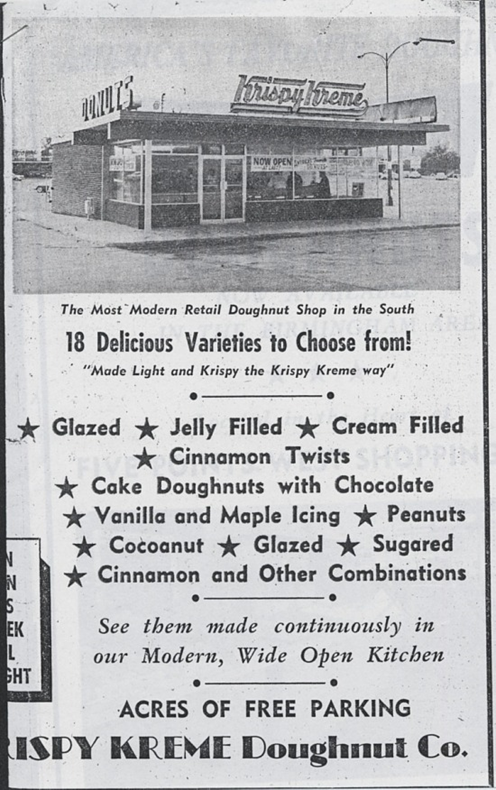
1937 Advertisement campaign
Initially, the business operated as a wholesale bakery supplying freshly produced doughnuts to local grocery stores and retailers. The business model was straightforward and reflected the realities of the period: produce consistently high-quality products in volume and distribute them efficiently to nearby outlets. There was little indication that this modest operation would eventually become one of the world's most admired bakery brands.

1938 Advertisements campaign
However, an unexpected event would fundamentally alter the company's trajectory. Residents passing the bakery became captivated by the irresistible aroma of freshly glazed doughnuts drifting onto the streets. Curious customers began knocking on the bakery door, requesting to purchase doughnuts directly from the production facility. Recognising this spontaneous demand, Rudolph literally cut a serving window into the exterior wall of the building and began selling hot doughnuts directly to consumers.
This seemingly simple decision represented far more than an operational adjustment; it marked the birth of Krispy Kreme's customer-centric philosophy. Instead of viewing production merely as manufacturing, the company transformed it into a public experience. Customers were no longer passive purchasers of a finished product; they became participants in the process, observing craftsmanship, enjoying unparalleled freshness and developing an emotional attachment to the brand itself.

This early innovation illustrates an important principle of strategic management: transformative opportunities often emerge not through complex technological breakthroughs but through attentive listening to customers. Krispy Kreme did not invent the doughnut. Rather, it reinvented the experience surrounding the doughnut by recognising that consumers valued freshness, authenticity and human connection as much as the product itself.


The lesson is particularly relevant for South African coffee businesses. Many cafés continue to view coffee preparation as a purely operational activity hidden behind counters or within kitchen spaces. Yet modern consumers increasingly seek experiences rather than transactions. Open brewing stations, visible roasting operations, latte art demonstrations and direct engagement between baristas and customers all transform coffee preparation into a form of experiential hospitality. In this respect, Krispy Kreme anticipated contemporary experience-based marketing decades before the concept became established within management literature.

As the company expanded throughout the United States during the post-war economic boom, it maintained a delicate balance between operational standardisation and local community engagement. Every new store sought to replicate the same quality standards while preserving the excitement of witnessing fresh doughnuts being produced before customers' eyes. This consistency gradually became synonymous with the Krispy Kreme brand, reinforcing customer trust and encouraging repeat patronage.

From humble beginning to massive warehouse facility
The company's evolution therefore illustrates one of the central themes of this research series: sustainable competitive advantage is rarely created by extraordinary products alone. Rather, it emerges from the ability to consistently transform ordinary products into extraordinary customer experiences. Krispy Kreme's history demonstrates that excellence begins not with complexity but with disciplined attention to the seemingly simple details that customers remember long after the purchase has been completed.
This historical foundation provides the basis for understanding the entrepreneurial philosophy that shaped the organisation—an examination that forms the focus of the next section.
2. The Founder and Entrepreneurial Vision: Vernon Rudolph and the Leadership Principles Behind Krispy Kreme's Success
The historical evolution of Krispy Kreme demonstrates that remarkable organisations rarely emerge by accident. Behind every enduring global brand is an entrepreneur whose vision extends beyond the immediate objective of selling a product. While many businesses concentrate on production efficiency or short-term profitability, truly exceptional enterprises are often founded by individuals who possess the ability to recognise opportunities where others perceive only ordinary commodities. The story of Krispy Kreme therefore cannot be understood without examining the entrepreneurial vision of its founder, Vernon Rudolph, whose leadership philosophy laid the foundation for one of the world's most recognisable bakery brands.
When Rudolph established Krispy Kreme in 1937, the economic environment in the United States remained uncertain following the Great Depression. Financial resources were limited, consumer confidence was fragile, and competition among small food businesses was intense. Under such circumstances, many entrepreneurs focused primarily on survival. Rudolph, however, demonstrated a different mindset. Rather than viewing the business simply as a bakery, he recognised that long-term success would depend upon building customer trust through consistency, quality, and memorable experiences.
This distinction is significant because it highlights one of the recurring themes within this research series. Excellence is seldom created by extraordinary products alone; it is cultivated through extraordinary thinking. Rudolph did not invent the doughnut, nor did he possess exclusive access to ingredients unavailable to competitors. His competitive advantage emerged from his ability to envision possibilities beyond the product itself. He understood that customers would return repeatedly if they could rely on consistent quality, exceptional freshness, and a purchasing experience that generated positive emotions.
The decision to sell directly from the bakery, prompted initially by customers attracted by the aroma of freshly produced doughnuts, illustrates Rudolph's responsiveness to market signals. Many business owners would have regarded such interruptions as distractions from production. Rudolph instead interpreted customer curiosity as valuable market intelligence. By literally creating a serving window through the bakery wall, he transformed spontaneous demand into a new business model. This seemingly modest innovation reflected an entrepreneurial characteristic consistently observed among successful business leaders: the willingness to adapt quickly while remaining faithful to the organisation's core purpose.
Strategic management scholars frequently emphasise that entrepreneurial success depends upon opportunity recognition rather than resource abundance. Rudolph's experience supports this proposition. Without sophisticated technology, extensive capital, or elaborate marketing campaigns, he leveraged intangible assets such as customer goodwill, product freshness, and operational authenticity. In doing so, he demonstrated that sustainable competitive advantage often begins with understanding customer behaviour more effectively than competitors.
This philosophy resonates strongly with the work of Peters and Waterman, whose research identified customer closeness as one of the defining characteristics of excellent organisations. Businesses that consistently outperform competitors rarely become inward-looking bureaucracies. Instead, they remain attentive to changing customer expectations, encourage frontline innovation, and empower employees to improve service delivery continuously. Rudolph's actions reflected these principles decades before they became formalised within management literature.
Equally important was his unwavering commitment to product consistency. Entrepreneurs often seek rapid expansion before establishing reliable operating systems. Rudolph pursued a different path. He recognised that every doughnut represented the reputation of the business. Consistency therefore became a non-negotiable organisational value rather than a technical production objective. Customers developed confidence because each visit delivered the same standard of freshness, taste, texture, and service. This consistency gradually evolved into one of Krispy Kreme's most valuable strategic assets.
For coffee entrepreneurs, this lesson carries profound significance. Many independent cafés invest heavily in premium coffee beans, advanced espresso equipment, and attractive interior design. While these investments are undoubtedly important, customers ultimately judge a café by the consistency of their experience. An exceptional cappuccino served today but an average one tomorrow weakens customer confidence regardless of bean quality. Rudolph's philosophy reminds hospitality businesses that consistency builds trust, and trust builds loyalty.
Another defining characteristic of Rudolph's leadership was his understanding of simplicity. Contemporary management frequently associates innovation with technological complexity. Yet Krispy Kreme's founder demonstrated that innovation can emerge through refining simple ideas to extraordinary levels of execution. Rather than diversifying excessively or pursuing unrelated ventures, the company concentrated relentlessly on perfecting a limited product range and delivering it exceptionally well. This strategic discipline enabled operational efficiencies, strengthened brand recognition, and prevented the organisational dilution that often accompanies uncontrolled diversification.
This principle aligns closely with Jim Collins' concept of the "Hedgehog Concept" presented in Good to Great, where organisations achieve sustained success by focusing intensely on what they can become exceptionally good at rather than attempting to excel across numerous unrelated activities. Although Collins' work was published decades after Krispy Kreme's founding, Rudolph's leadership exemplified this philosophy long before it acquired theoretical recognition.
Furthermore, Rudolph intuitively understood the importance of organisational culture. Although the company remained relatively small during its early years, employees were expected to value craftsmanship, cleanliness, customer satisfaction, and teamwork. These cultural values gradually became embedded within the organisation and proved essential as Krispy Kreme expanded through franchising. Processes could be documented, recipes could be replicated, and equipment could be standardised, but sustaining the brand ultimately depended upon preserving the culture established by its founder.
The hospitality industry provides numerous examples demonstrating that organisational culture directly influences customer perceptions. Hotels, restaurants, cafés, and tourism establishments all deliver intangible experiences shaped primarily by employee attitudes and behaviour. Consequently, culture becomes a strategic resource rather than merely an internal management concern. Rudolph recognised that every employee represented the brand and contributed to the customer experience, a principle equally applicable to modern coffee shops throughout South Africa.
Perhaps Rudolph's greatest contribution, however, was his appreciation of emotional value creation. Customers did not simply purchase doughnuts because they were hungry. They purchased moments of pleasure, nostalgia, comfort, celebration, and shared experiences. By focusing on these emotional dimensions, Krispy Kreme elevated its product beyond functional consumption and created enduring psychological connections with consumers. This emotional branding would later become one of the company's most powerful competitive advantages as it expanded internationally.
The coffee industry increasingly operates according to similar dynamics. Consumers rarely visit speciality cafés solely because they require caffeine. They seek welcoming environments, authentic interactions, opportunities for social connection, and experiences that reflect their personal identities. Successful cafés therefore compete as much on emotional engagement as on beverage quality. Rudolph's entrepreneurial vision anticipated this experiential economy decades before it became a dominant feature of contemporary hospitality management.
For South African entrepreneurs, particularly those operating independent cafés and hospitality businesses, Vernon Rudolph's legacy offers valuable strategic guidance. His success demonstrates that global brands are not necessarily built through substantial financial resources or revolutionary inventions. They are built through clear purpose, disciplined execution, customer-centred thinking, operational consistency, and the ability to transform ordinary products into memorable experiences. These qualities remain accessible to entrepreneurs regardless of business size or geographical location.
The leadership philosophy established by Rudolph also reinforces the central argument of this research series. Thinking globally does not require imitating international corporations; rather, it requires adopting world-class principles while responding creatively to local opportunities. Acting locally means understanding the unique needs of South African consumers, celebrating local culture, supporting local producers, and delivering authentic hospitality with uncompromising consistency. When these principles are combined, even modest enterprises possess the potential to achieve extraordinary success.
Having examined the entrepreneurial vision that shaped Krispy Kreme's culture and strategic direction, the discussion now turns to the organisational systems that transformed this vision into a scalable global enterprise. Understanding how the company converted entrepreneurial ambition into a sustainable business model provides further insight into why some organisations succeed far beyond their competitors while selling products that remain fundamentally ordinary.
3. Coffee Excellence Insights
Thinking Globally, Acting Locally
Every successful global brand leaves behind strategic lessons that transcend its products. The purpose of this research is not to encourage South African coffee entrepreneurs to imitate Krispy Kreme, but rather to understand the universal principles that transformed an ordinary bakery into a globally respected organisation. Excellence is transferable because it is built upon disciplined leadership, organisational culture, operational consistency, customer obsession, and strategic innovation rather than on products alone.
Lesson 1: Products Rarely Create Competitive Advantage—Experiences Do
Krispy Kreme demonstrates that consumers purchase far more than food. They purchase anticipation, freshness, excitement, nostalgia, and emotional satisfaction. The famous "Hot Now" sign became a powerful symbol because it promised an experience rather than simply a doughnut.
For South African coffee businesses, this lesson is profound. Customers may initially visit because of coffee, but they return because of how the café makes them feel. Every interaction—from the greeting at the entrance to the aroma of freshly ground coffee, the friendliness of the barista, the ambience, music, presentation, and farewell—collectively shapes the customer experience. Coffee therefore becomes the centrepiece of a broader hospitality experience rather than the sole product.
Lesson 2: Consistency Builds Trust
One of Krispy Kreme's greatest competitive strengths has always been consistency. Customers know that regardless of location, the product and service will reflect the same high standards. Such consistency does not occur accidentally; it results from disciplined systems, clearly defined operating procedures, continuous training, and uncompromising quality management.
South African cafés often excel when owners are personally present but struggle to maintain standards during staff changes or busy trading periods. Sustainable businesses therefore depend upon systems rather than personalities. Recipes, brewing standards, customer service protocols, hygiene procedures, and product presentation should become organisational habits rather than individual preferences.
Lesson 3: Simplicity Executed Brilliantly Outperforms Complexity Executed Poorly
Krispy Kreme built an international reputation by mastering a relatively small product portfolio instead of attempting to become everything to everyone. Operational simplicity improved quality, strengthened the brand, reduced waste, and increased efficiency.
Many emerging coffee businesses introduce extensive menus before perfecting their core offerings. The pursuit of excellence requires strategic discipline. A café that consistently produces outstanding espresso, cappuccino, flat white, and carefully selected food items will often outperform competitors offering dozens of mediocre alternatives. Excellence is achieved through mastery rather than excess.
Lesson 4: Organisational Culture Determines Customer Experience
Buildings do not create hospitality; people do. Krispy Kreme's enduring reputation has been sustained by employees who consistently deliver warmth, enthusiasm, professionalism, and pride in their work. Organisational culture therefore becomes visible through every customer interaction.
For café owners, culture begins with leadership. Employees who feel respected, supported, trained, and inspired are far more likely to create memorable experiences for customers. Investment in staff development should therefore be regarded not as an expense but as a strategic investment in brand equity.
Lesson 5: Innovation Often Lies in Refining the Ordinary
Krispy Kreme did not invent the doughnut. Instead, it continuously refined production processes, customer engagement, store design, operational systems, and marketing strategies until an ordinary bakery product became a globally admired experience.
Similarly, South African coffee entrepreneurs need not search endlessly for revolutionary ideas. Innovation frequently involves improving existing practices through better service, stronger storytelling, digital engagement, sustainability initiatives, locally inspired menu offerings, and community partnerships. Incremental improvements implemented consistently frequently produce transformational results over time.
Lesson 6: Think Beyond Selling Coffee
Perhaps the most important lesson emerging from Krispy Kreme is that globally respected brands do not define themselves by the products they sell. They define themselves by the value they create.
Starbucks does not merely sell coffee.
McDonald's does not merely sell hamburgers.
Krispy Kreme does not merely sell doughnuts.
They create experiences, relationships, memories, trust, and emotional connections that customers willingly revisit and recommend.
South African cafés should therefore ask a more strategic question:
"What business are we really in?"
The answer may not be coffee.
It may be hospitality.
It may be community.
It may be education.
It may be wellness.
It may be creativity.
Or it may simply be creating happiness—one perfectly prepared cup at a time.
Comparative Synthesis Table: Starbucks vs McDonald’s
Figure: Two Models of Global Excellence
Dimension | Starbucks | McDonald’s |
Core Value Proposition | Experience & meaning | Reliability & efficiency |
Primary Differentiator | Third Place culture | Process discipline |
Human Capital Role | Skilled, relational | Procedural, standardized |
Customer Motivation | Belonging, identity | Speed, predictability |
Price Logic | Premium | Value-based |
Scalability Risk | Experience dilution | Brand commoditization |
Insight:Starbucks and McDonald’s represent orthogonal strategies. Neither is inherently superior; effectiveness depends on market context, consumer psychology, and execution discipline.
Reflection
The Krispy Kreme story reinforces one of the central propositions advanced throughout In Search of Coffee Excellence: Thinking Globally, Acting Locally. Global success is rarely the consequence of extraordinary products. Instead, it is achieved through extraordinary execution, disciplined leadership, organisational learning, customer obsession, and an unwavering commitment to excellence.
South African coffee entrepreneurs possess access to exceptional coffee, talented baristas, diverse cultures, remarkable tourism attractions, and entrepreneurial creativity. The challenge is therefore not whether South Africa can produce globally competitive coffee brands, but whether local businesses are prepared to embrace the principles of excellence that distinguish world-class organisations from ordinary competitors.
Thinking globally begins with adopting international standards of quality, leadership, innovation, and customer experience.
Acting locally means expressing those standards through authentic South African hospitality, local sourcing, cultural diversity, and meaningful community engagement.
When these two philosophies are integrated, local cafés have the potential to evolve into internationally admired brands while remaining deeply rooted within the communities they serve.
4. Business Model and Revenue Architecture: Building a Scalable Enterprise
The history of global business repeatedly demonstrates that visionary leadership, while indispensable, is insufficient on its own to create sustainable organisational success. Many entrepreneurs establish promising businesses based on innovative ideas, exceptional products, or passionate commitment, yet relatively few succeed in transforming those enterprises into scalable organisations capable of sustained growth across national and international markets. The critical distinction lies not merely in entrepreneurial vision but in the development of a business model capable of delivering consistent value while generating long-term financial sustainability.
Krispy Kreme provides a compelling illustration of this principle. While the company's reputation has largely been built upon its iconic glazed doughnut and memorable customer experience, its enduring success is equally attributable to the strategic architecture underpinning its operations. Beneath the aroma of freshly baked doughnuts and the excitement generated by the famous "Hot Now" sign exists a carefully designed business model that integrates manufacturing, retailing, franchising, logistics, brand management, and customer engagement into a highly coordinated system.
This observation reinforces one of the central arguments advanced throughout this research series. Global organisations rarely achieve excellence because they possess superior products alone. Rather, they develop systems that consistently deliver quality, efficiency, profitability, and customer satisfaction regardless of geographical location. Excellence therefore becomes institutionalised within the organisation rather than dependent upon individual personalities.
From Product Business to Experience Business
At first glance, Krispy Kreme appears to operate as a bakery. However, a closer strategic analysis reveals that the organisation functions as an integrated experience business. Every component of the enterprise is designed to reinforce customer perceptions of freshness, quality, authenticity, and enjoyment.
The doughnut itself represents only one element of a much broader value proposition. Customers are simultaneously purchasing convenience, theatre, nostalgia, trust, consistency, and emotional satisfaction. The open production process, the visual appeal of glazed doughnuts moving along conveyor systems, the unmistakable aroma within each store, and the anticipation created by the illuminated "Hot Now" sign collectively transform a simple food purchase into an immersive sensory experience.
This distinction is particularly important for coffee entrepreneurs. Too often cafés define themselves solely by the beverages they serve. Yet customers increasingly evaluate hospitality establishments according to the totality of their experience rather than the technical quality of individual products. Atmosphere, service, cleanliness, storytelling, design, music, community engagement, and emotional connection frequently determine whether customers become loyal advocates or occasional visitors.
Consequently, the primary lesson from Krispy Kreme is that businesses should not define themselves according to what they manufacture but according to the value they create.
Diversified Revenue Streams
Another defining characteristic of Krispy Kreme's business model is its diversified approach to revenue generation. Although retail store sales remain highly visible, the organisation deliberately developed multiple complementary income streams that reduce operational risk while strengthening brand presence.
Traditional company-owned stores generate direct consumer revenue through walk-in purchases, beverages, seasonal products, and promotional offerings. These flagship locations simultaneously function as marketing platforms where customers experience the theatre of doughnut production.
Franchised stores represent a second major source of growth. By partnering with qualified franchise operators, Krispy Kreme expanded internationally without assuming the full financial burden of establishing every new outlet. Franchisees invest capital, manage local operations, and contribute ongoing royalties while adhering to strict operational standards established by the parent company.
The organisation further strengthened its market position by supplying supermarkets, convenience stores, petrol stations, airports, universities, shopping centres, and other retail partners. This wholesale distribution strategy significantly extended consumer access to the brand while generating additional revenue beyond traditional retail outlets.
More recently, digital ordering platforms, delivery partnerships, loyalty programmes, and online promotions have expanded customer convenience while generating valuable consumer data that informs future marketing strategies.
Collectively, these diversified revenue streams illustrate a fundamental principle of business sustainability: successful organisations avoid dependence upon a single source of income. Instead, they construct complementary revenue channels that reinforce one another while increasing organisational resilience.
5. Standardisation as a Strategic Asset
Perhaps the most remarkable feature of Krispy Kreme's business model is its commitment to operational standardisation. Every aspect of production, from ingredient specifications and equipment calibration to glazing procedures and customer service protocols, is governed by carefully documented systems designed to ensure consistency across all locations.
Standardisation serves multiple strategic purposes. It protects product quality, facilitates employee training, simplifies quality assurance, strengthens brand identity, and enables rapid expansion into new markets. More importantly, it builds customer confidence. Consumers expect the same familiar experience whether purchasing a doughnut in Johannesburg, London, Sydney, or New York.
For hospitality businesses, standardisation should never be confused with rigidity. Rather, it provides a stable operational foundation upon which creativity and local adaptation can flourish. Customers appreciate innovation, but they also value reliability. World-class organisations consistently balance these seemingly opposing objectives.
6. Franchising: Replicating Excellence
Franchising has long been recognised as one of the most effective mechanisms for accelerating business growth. However, successful franchising depends upon more than granting permission to use a recognised brand. It requires the replication of organisational culture, operational systems, quality standards, marketing practices, and customer experiences.
Krispy Kreme understood that its reputation represented its most valuable strategic asset. Consequently, franchise operators are expected to maintain rigorous standards regarding production, service, cleanliness, employee training, and brand presentation. This disciplined approach ensures that customers experience the same core values regardless of geographical location.
For emerging South African coffee brands, this lesson is particularly instructive. Expansion should not occur simply because market opportunities exist. Growth must be supported by systems capable of preserving quality and protecting brand reputation. Premature expansion without operational discipline often damages customer confidence and weakens long-term competitiveness.
Data, Technology and Continuous Improvement
Modern business models increasingly depend upon information rather than intuition alone. Krispy Kreme has progressively integrated technology into forecasting demand, managing inventory, supporting digital marketing, enhancing customer engagement, and improving operational efficiency.
Technology, however, functions as an enabler rather than a substitute for leadership. Successful organisations utilise data to improve decision-making while remaining focused on their fundamental mission of creating value for customers.
Independent cafés can adopt similar principles on an appropriate scale. Simple technologies such as customer relationship management systems, loyalty applications, digital payment platforms, online reservations, and inventory management software can significantly improve operational performance without compromising personalised service.
Strategic Lessons for South African Coffee Entrepreneurs
The architecture of Krispy Kreme's business model offers valuable insights for coffee entrepreneurs seeking sustainable growth within South Africa's increasingly competitive hospitality sector.
First, businesses should define themselves according to the experiences they create rather than the products they sell.
Second, operational systems should be documented, measured, and continuously improved to ensure consistent quality regardless of staff turnover or business expansion.
Third, diversified revenue streams—including retail sales, packaged coffee, catering, training, merchandise, online sales, corporate partnerships, and subscription services—can strengthen financial resilience while enhancing customer engagement.
Fourth, growth should be supported by disciplined operational frameworks capable of protecting brand reputation before pursuing additional locations or franchising opportunities.
Finally, technology should complement rather than replace authentic hospitality. Digital innovation becomes most valuable when it enhances customer convenience while preserving the human interactions that define memorable café experiences.
South African Coffee Excellence Framework
A Contextualized Excellence Model for South Africa:
Pillar 1: Product Integrity– Quality beans– Roasting competence– Taste consistency
Pillar 2: Operational Discipline– Standardized processes– Scalable training systems– Supply chain reliability
Pillar 3: Experience & Cultural Relevance– Local storytelling– Community embeddedness– Spatial design sensitivity
Pillar 4: Ethical & Inclusive Value Chains– African sourcing visibility– Youth and skills development– Fair labor practices
Pillar 5: Strategic Focus– Clear positioning (experience, efficiency, or emotion)– Avoidance of overextension
Key Principle:South African coffee brands must hybridize global discipline with local authenticity—not imitate multinational giants wholesale.
Policy and Industry Recommendations
1. For Industry Leaders
Invest in systems before scale
Treat baristas and operators as brand infrastructure, not labor inputs
Choose a clear strategic lane (experience, efficiency, or product obsession)
2. For Policymakers
Support local roasting and processing through targeted incentives
Facilitate access to regional export markets within Africa
Align youth skills programs with hospitality and coffee value chains
3. For Educational Institutions
Integrate coffee and food service case studies into business curricula
Emphasize operations, ethics, and consumer behavior—not just entrepreneurship narratives
4. For Emerging Entrepreneurs
Start narrow, execute deeply
Build trust before ambition
Let excellence precede expansion
The Journey Ahead
The story of Krispy Kreme illustrates how a brand can grow and thrive while staying true to its core values. From its humble beginnings in North Carolina to becoming a global icon, the rise of Krispy Kreme exemplifies the significance of innovation, flexibility, and strong customer connections.
With a solid business model, unwavering dedication to quality, and a focus on community involvement, Krispy Kreme crafts not just delicious doughnuts but also meaningful relationships with customers worldwide. The future holds exciting possibilities for this beloved brand, and it will be captivating to see how Krispy Kreme continues to evolve within the doughnut industry in the years to come.
Transition to the Next Chapter
Understanding Krispy Kreme's business model reveals how entrepreneurial vision was translated into sustainable organisational systems. Yet even the most sophisticated business model cannot guarantee customer loyalty unless it creates memorable experiences that distinguish the brand from competitors.
This observation leads naturally to the next dimension of the company's success. Perhaps no aspect of Krispy Kreme better illustrates the power of experiential marketing than its famous "Hot Now" philosophy. More than a promotional device, it became a symbol of anticipation, authenticity, and emotional engagement that transformed an ordinary bakery visit into a memorable event. Examining this phenomenon provides deeper insight into how global brands convert routine purchases into enduring customer relationships. In the next episode of these series of blog I will be providing insight on Coca Cola worldwide empire and its century of successful international operation.
About Author:

Salman Khan is a Barista judge, internationally acclaimed human rights activist, social entrepreneur, food and drink anthropologist, researcher and culinary educator.
To access 2024 coffee consumer survey report in South Africa please send an email to by a copy of it.
WhatsApp 082 691 6048
#SCASA #coffeesustainbility #ecological #envirnomentalstewardship #coffeefairtrade #sauNotoexploitation #coffeeequitability #SCA #coffeecommunity #arabia #robusta #fairtrade #Africacoffee #coffeeplantation #coffeetourism #DTIc #Tourism #agriculture #climatechange #baristaguild #CoffeeUSA #CoffeeEU #CoffeeManagize #coffeeroasters #coffeeUAE #CoffeeBeans #UNITC #WTO #UJ #Wits #UKZN #UCT
References — Krispy Kreme
· Krispy Kreme, Inc. (2023). Form 10-K Annual Report. Charlotte, NC: Krispy Kreme, Inc.
· Love, J. F. (2003). Krispy Kreme: The Official Guide to the World’s Sweetest Brand. New York, NY: Hyperion.
· Schlosser, E. (2012). Fast Food Nation: The Dark Side of the All-American Meal (Rev. ed.). New York, NY: Houghton Mifflin Harcourt.(Used contextually for fast-food branding and franchising dynamics.)
· Pine, B. J., & Gilmore, J. H. (1999). The Experience Economy: Work Is Theatre & Every Business a Stage. Boston, MA: Harvard Business School Press.
· Keller, K. L. (2013). Strategic Brand Management: Building, Measuring, and Managing Brand Equity (4th ed.). Harlow, UK: Pearson Education.
· World Coffee Portal. (2022). Branded foodservice and indulgence-led consumption trends. London, UK.
Appendix C: References and Further Reading foundational Management and Strategy Literature
Peters, T., & Waterman, R. H. (1982). In Search of Excellence: Lessons from America’s Best-Run Companies. New York: Harper & Row.
Porter, M. E. (1985). Competitive Advantage: Creating and Sustaining Superior Performance. New York: Free Press.
Mintzberg, H. (1994). The Rise and Fall of Strategic Planning. New York: Free Press.
Branding, Marketing, and Consumer Culture
Aaker, D. A. (1996). Building Strong Brands. New York: Free Press.
Keller, K. L. (2013). Strategic Brand Management (4th ed.). Harlow: Pearson.
Holt, D. B. (2004). How Brands Become Icons: The Principles of Cultural Branding. Boston: Harvard Business School Press.
Globalization and Multinational Enterprises
Bartlett, C. A., & Ghoshal, S. (1989). Managing Across Borders: The Transnational Solution. Boston: Harvard Business School Press.
Rugman, A. M., & Collinson, S. (2012). International Business (6th ed.). Harlow: Pearson.
Levitt, T. (1983). “The Globalization of Markets.” Harvard Business Review, 61(3), 92–102.
Industry-Specific and Practitioner Sources
Schultz, H., & Yang, D. J. (1997). Pour Your Heart Into It: How Starbucks Built a Company One Cup at a Time. New York: Hyperion.
Love, J. F. (1995). McDonald’s: Behind the Arches. New York: Bantam Books.
Pendergrast, M. (2013). For God, Country, and Coca-Cola. New York: Basic Books.
Coffee Economy and Emerging Market Perspectives
Ponte, S. (2002). “The ‘Latte Revolution’? Regulation, Markets and Consumption in the Global Coffee Chain.” World Development, 30(7), 1099–1122.
Talbot, J. M. (2004). Grounds for Agreement: The Political Economy of the Coffee Commodity Chain. Lanham: Rowman & Littlefield.
International Coffee Organization (ICO). Selected reports and statistical publications.


Comments